
March 20th, 2025
By: WoodTV
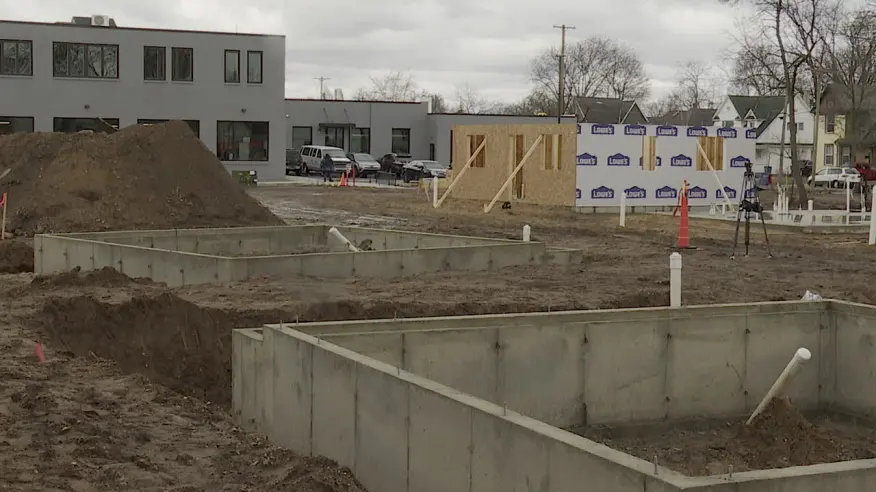
GRAND RAPIDS, Mich. (WOOD) — Mel Trotter Ministries and subsidiary Next Step of West Michigan on Thursday celebrated the placement of the last wall on their first tiny home, part of a project aimed at breaking the cycle of poverty and homelessness.
“It means a lot. I never imagined that I would be somebody to help another person,” Darrion Boyd, the carpenter who secured the fourth wall of the first home at Hope Village, said.
He said Next Step, which offers skilled trades training to people working to overcome addiction and homelessness, helped him change his life.
“(I was) in and out of the streets, not making the best decisions in my life. And I wanted to do something different, make a change, do something with a positive impact,” he said. “I would never think I’d be doing construction as a trade career or job. Coming to Next Step, it opened up opportunities for me and I hope I can send out a message to people that they can have the same opportunity.”
When finished, Hope Village will include 16 tiny homes on just under 2 acres near the Next Step facility on Garden Street SE near S. Division Avenue in Grand Rapids. The first 10 homes should be done by the end of summer.
Ranging in size from 400 to around 530 square feet, the homes will be fully furnished, with in-unit washers, dryers and bathrooms.
“We wanted to make a community. We wanted to make a place that is nice and feels like home,” Mel Trotter CEO Chris Paulsky said.
He said that sense of community can help people overcome some of the problems that contribute to addiction and homelessness.
Residents will pay rent, but part of that will be saved for them to use as a down payment on a house or deposit on a new apartment when they move out of Hope Village.
“It’s wonderful as a starter home. So we see this as a place where people can go from a shelter, maybe from transitional housing into a permanent home,” Palusky said.
The homes are a part of a program to get people out of Mel Trotter’s shelter by helping them build a stable life through work. Participants learn skills and trades at the Next Step manufacturing facility and are able to earn a living wage as they help assemble the structures.
“We always try to prevent people from becoming homeless. We don’t want people to be homeless, and if they come to our shelter, we don’t want them to stay,” Paulsky said. “To do that, sometimes you need mental health care, addiction issues (treatment), skill training, job training, housing. And this is one piece to help people live a life in a home.”
Mel Trotter and Next Step say Hope Village still needs donations to come to fruition, and they are always accepting help from volunteers.
Right now, Next Step offers a seven-week training program in wood manufacturing and general construction, then helps graduates secure employment. With a $300,000 grant it recently got from Lowe’s, it plans to soon develop the carpentry program into a full on-the-job training model.
